
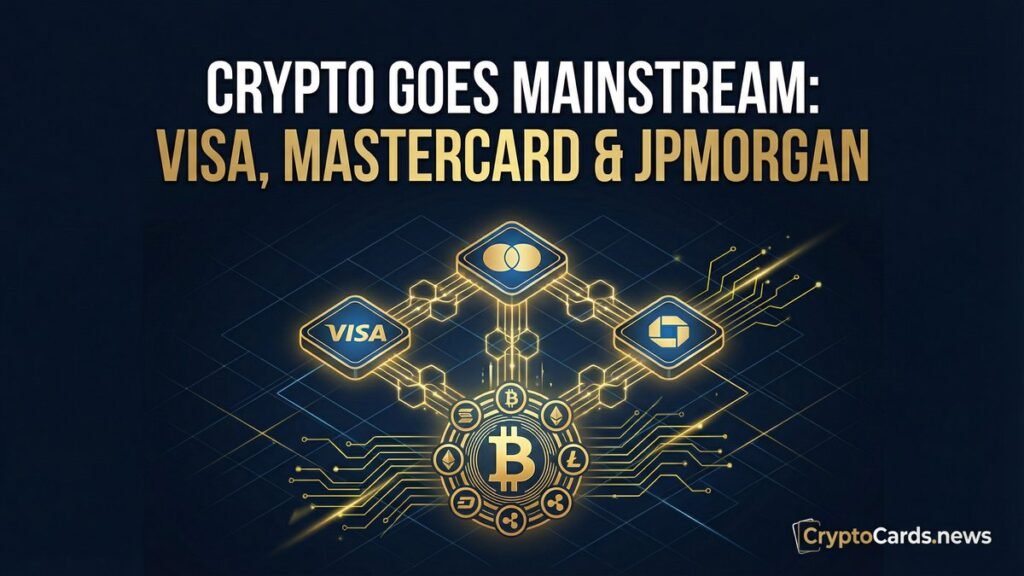
While the launch of spot Bitcoin ETFs dominated headlines and captured the public’s imagination, a quieter, arguably more significant revolution is taking place beneath the surface. Cryptocurrency is rapidly going mainstream, not just as an investment asset, but as a foundational technology for global financial infrastructure. Major players like Visa, Mastercard, and JPMorgan are actively integrating blockchain technology into their core operations, signaling a profound shift in the financial landscape.
This structural integration moves beyond the speculative trading of digital assets. It focuses on leveraging the efficiency, transparency, and speed of blockchain networks to solve real-world problems in cross-border payments, tokenization, and settlement. The era of crypto as a niche experiment is over; the era of crypto as financial utility has begun.
Visa and Mastercard: Building Next-Gen Payment Rails
The world’s largest payment networks, Visa and Mastercard, are not standing idly by as blockchain technology evolves. They are actively building the next generation of payment rails. Visa, for instance, is already processing stablecoin settlements across 50 countries, utilizing networks like Solana to facilitate near-instantaneous, low-cost cross-border transactions.
Mastercard is similarly engaged, developing infrastructure to support Central Bank Digital Currencies (CBDCs) and tokenized bank deposits. By integrating blockchain into their existing networks, these giants are bridging the gap between traditional finance (TradFi) and decentralized finance (DeFi), making crypto payments seamless for millions of merchants and consumers worldwide.
JPMorgan and the Tokenization of Assets
JPMorgan, a titan of traditional banking, has been a pioneer in institutional blockchain adoption. Through its Onyx platform, the bank is facilitating the tokenization of real-world assets (RWAs) and executing intraday repurchase agreements using its proprietary JPM Coin. This allows for the instantaneous transfer of value and collateral, significantly reducing settlement risk and freeing up capital.
The tokenization of assets—ranging from real estate to Treasury bonds—represents a massive opportunity. By representing physical assets as digital tokens on a blockchain, institutions can increase liquidity, enable fractional ownership, and streamline complex financial transactions. JPMorgan’s active involvement validates the immense potential of this technology.
The Shift from Speculation to Utility
The narrative surrounding cryptocurrency is fundamentally changing. For years, the focus has been on price volatility and speculative trading. However, the actions of Visa, Mastercard, and JPMorgan highlight a shift toward utility. Blockchain is increasingly viewed as a superior technological layer for moving and managing value.
This transition is crucial for the long-term sustainability of the crypto ecosystem. While ETFs provide a convenient on-ramp for investors, the integration of blockchain into everyday financial operations ensures that the technology will have a lasting impact on the global economy, regardless of short-term price fluctuations.
Regulatory Frameworks and Institutional Confidence
The mainstream adoption of crypto infrastructure is heavily dependent on regulatory clarity. As governments worldwide develop comprehensive frameworks, such as the European Union’s MiCA regulation, institutional confidence grows. Clear rules of the road mitigate risk and provide the legal certainty necessary for massive financial institutions to deploy capital and resources into blockchain initiatives.
The ongoing dialogue between regulators and industry leaders is shaping a future where digital assets and traditional finance coexist and interoperate seamlessly. This regulatory maturation is the catalyst that will unlock the full potential of blockchain technology on a global scale.
What This Means for Crypto Users
For everyday crypto users, the structural integration of blockchain by major financial institutions is highly bullish. It means that the technology underlying their digital assets is being validated and adopted by the most powerful players in global finance. This adoption will lead to more robust infrastructure, improved user experiences, and greater acceptance of crypto payments.
Users can expect to see more seamless integrations between their crypto wallets and traditional financial services. The ability to spend stablecoins as easily as swiping a credit card, or to access tokenized real-world assets, will become increasingly commonplace, blurring the lines between TradFi and DeFi.
Frequently Asked Questions (FAQ)
1. How is Visa using cryptocurrency?
Visa is using blockchain networks, such as Solana, to settle transactions using stablecoins like USDC. This allows for faster and cheaper cross-border payments compared to traditional settlement methods.
2. What is asset tokenization?
Asset tokenization is the process of converting rights to a real-world asset (like real estate or bonds) into a digital token on a blockchain. This increases liquidity, enables fractional ownership, and simplifies the transfer of the asset.
3. Why are traditional banks like JPMorgan interested in blockchain?
Banks are interested in blockchain because it offers significant efficiencies in settlement, clearing, and cross-border payments. It reduces counterparty risk, lowers operational costs, and enables new financial products through tokenization.
4. Does this mean I can pay for everyday items with Bitcoin?
While direct Bitcoin payments are becoming more common, the integration by Visa and Mastercard primarily focuses on stablecoins for settlement. However, this infrastructure makes it easier for consumers to fund their accounts with crypto and spend it seamlessly at merchants worldwide.